
Where Oldham Arrest News Appears
Start with the sources that answer a specific question. The Oldham County Police activity reports and the agency's press releases cover what officers did. The OCDC current-inmate page shows who is held at the jail today. Municipal police reports fill in the city-level gaps. These feeds do not overlap much. An incident PDF can log calls with no names and no pictures, while the roster only lists people currently in OCDC custody.
Want the photos? Oldham Voice posts dated "Oldham County Jail Activity" pieces that credit the data, details, and images to OCDC. The Oldham Era handles newspaper public-record and arrest coverage, including La Grange material in its archived pages, though it has no daily mugshot section. WAVE 3 steps in for major cases. That is regional case reporting, not a county booking feed.
Oldham News Source Comparison
| Outlet | Coverage | Photos? | Where |
|---|---|---|---|
| OCDC | Current jail custody and individual details | Image may load on a detail | Official roster |
| OCPD | Rolling activity PDFs and selected releases | Not in reviewed activity reports | Agency reports |
| Oldham Voice | Daily or near-daily jail activity | Yes, credited to OCDC | Stories index |
| Oldham Era | Weekly newspaper public records and arrests | Not confirmed in current coverage | Public-notice archive |
| WAVE 3 | Occasional major cases | Sometimes, case dependent | Regional story coverage |
| La Grange Police | Weekly physical and citation arrest text | No on reviewed page | City arrest page |
Neither WDRB nor WLKY offers a current Oldham mugshot or blotter page. A regional station should not stand in for a local arrest feed. That holds unless it has a county section, clear sourcing, and a steady publishing pattern.
For historical digging, the Oldham public-notice archive is the searchable newspaper route to Oldham Era public-record material.
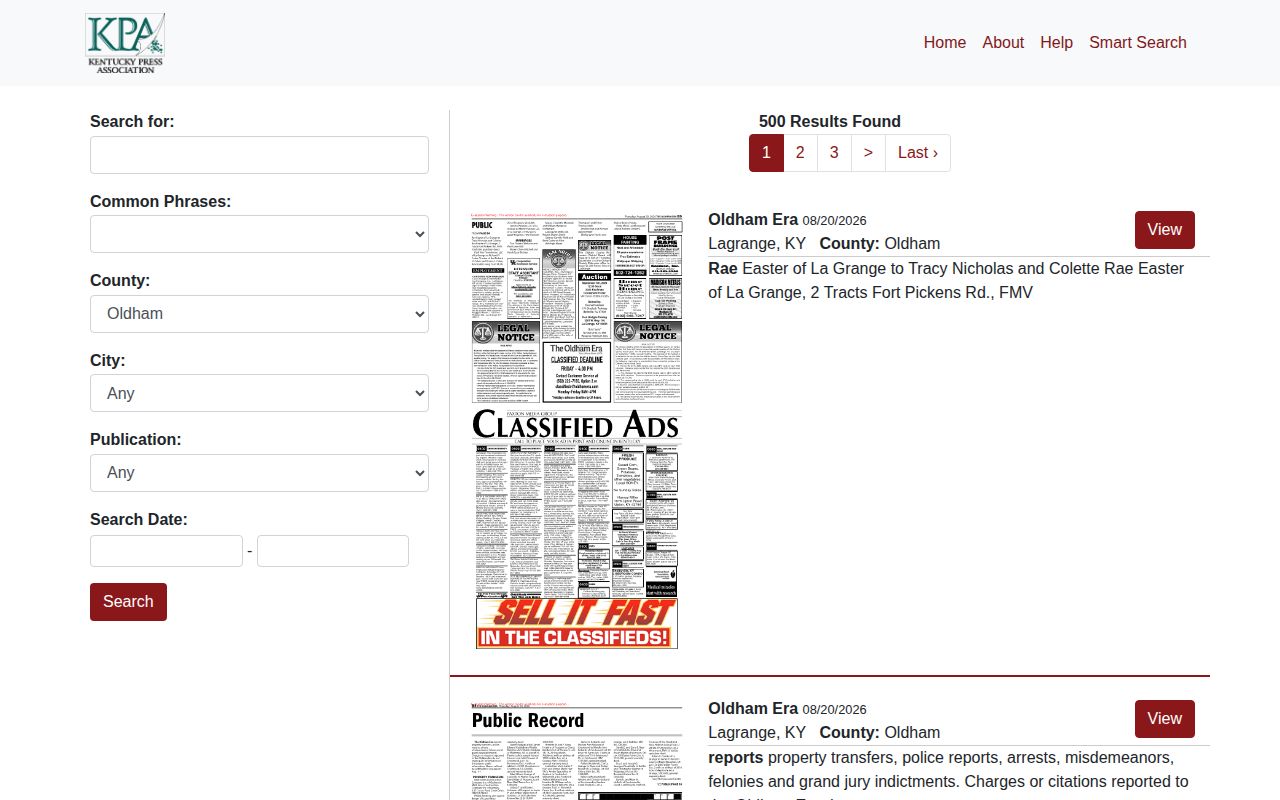
That archive helps with old news. It cannot tell you who is in custody now, and it does not replace what the court finally decides.
How Oldham Mugshots Reach News
How does a booking photo end up in print? A newsroom might get one with an agency release. It might pull one from the OCDC public interface. Or it can request the image from the records custodian. Oldham Voice says plainly that OCDC supplies its jail-activity data and images. That attribution matters. The paper republishes a county source rather than building its own custody record, and a dated article stays online long after the roster has moved on.
Records paths in Oldham County depend on who holds the file. OCDC handles its inmate records and booking-photo requests. The Sheriff runs its own open-records process for records it created. OCPD uses a NextRequest portal, with separate fees for reports and photographs. Kentucky open-records law lets agencies apply exemptions. So a public interface may not show every field in the full booking file.
From Oldham Story to Record
A dated story is a lead, not a legal history. Take the name to the office that created the booking or incident record. Then finish at the courthouse for the outcome. Two stops, and you have the whole trail.
- Record the exact name, publication date, stated arresting agency, and booking or incident date. Do not rely on the photograph as identity proof.
- Check the official OCDC roster treatment if the story concerns an Oldham County jail booking. A current result answers whether the person is in the selected jail view now.
- If no current result appears, request the older booking record from OCDC or the arrest record from the named agency. Release from the roster does not erase the underlying file.
- Use the Oldham County court page and CourtNet to find the related case, then ask the clerk for the authoritative docket or disposition.
- If the person later enters Kentucky prison or DOC supervision, use KOOL. It covers a different custody stage than a county booking.
Oldham Voice Mirrors OCDC Data
A typical Oldham Voice jail-activity story reports the prior day's bookings, shows booking fields and photographs, and credits OCDC. Nothing else in the county publishes photos that often. But it is a news window, not an official jail portal, so go by the article date rather than assuming anyone listed is still locked up.
This also explains why the news and the roster can disagree without either being wrong. The article freezes a booking event on a date. The roster only shows the present, shifting as people are released, transferred, or moved out of view. For custody-change alerts, VINE is the right channel.
Oldham Police Activity Is Not Booking
The OCPD daily PDF spans several dates. It lists each incident's date, number, type, location, and city. What it never shows is who got booked, the charges, or any photographs. Monthly and annual reports widen the lens with agency statistics. They confirm that police activity happened in an area. They cannot tell you who is sitting in OCDC.
La Grange's weekly page leans more toward arrests. The visible material runs older and has no photos. Crestwood points readers to OCPD agency reports, while Prospect puts out monthly police reporting from a city that straddles the Jefferson-Oldham line. Each city needs its own path: La Grange, Crestwood, and Prospect.
Unofficial Oldham Mugshot Archives
Third-party sites also host Oldham County booking photos: Busted Newspaper, Recently Booked, Mugshots.com, Arrests.org, and Mugshots.zone. Expect copied booking fields and photos, not completeness. Counts shift, coverage is spotty, and pages often linger after a person walks free. None of them replaces OCDC, the arresting agency, or the court.
Official sources always come first. Recently Booked and Busted Newspaper describe free correction routes for qualifying errors or favorable dispositions. Mugshots.com also outlines no-fee record maintenance when you supply documentation. Arrests.org has no verified Oldham-specific free process, and Mugshots.zone has no verified free-removal policy. Never pay a removal intermediary on a promise. Kentucky's anti-pay-to-remove statute and the home page's law section lay out the safer official and publisher routes. Treat these unofficial pages as leads only. Compare anything you find against the current OCDC record and the court file.
Request an Oldham News Photo
Go to the right office for the right image. Booking photos from OCDC go through the detention center's open-records policy. Have the full inmate name and date of birth ready before you fill anything out. Photos or incident files from OCPD come through the OCPD records portal instead. La Grange keeps its own path for city police material. Flooding the Sheriff with everything just because an arrest happened slows you down.
Archive Oldham Arrest Coverage Carefully
Digging for older coverage? Three sources stand out. The Oldham County Public Library newspaper archive, Oldham History Center collections, and the NewzGroup public-notice archive all hold historical material. Treat them as newspaper and history tools, though, not live custody trackers. An old arrest item in print tells you about the arrest, not what a court later decided.
Kentucky's county-jailer retention schedule keeps certain jail record series for five years after release. The public vendor roster stays current-focused. A retention rule does not guarantee online browsing. A destroyed record does not erase the fact that an arrest once occurred, either. For anything dated, ask OCDC whether the series is active, archived, transferred, restricted, or destroyed. Then check the court and newspaper sources.
Read Oldham Booking Dates Correctly
Dates trip people up constantly. A publication date, an arrest date, an intake date, and a release date are four different things. Oldham Voice often titles a jail-activity post for one day and posts it the next. OCPD's rolling daily report can stretch across several days at once. A court filing may come later still. When you compare sources, write down which date each one actually labels rather than assuming they match.
The OCDC current interface puts people front and center in its active view. Its vendor configuration separately reported a released-retention setting. That setting does not make the visible roster a guaranteed archive. A dated news story can sit online while the person named in it has already dropped off a current search. Neither source gives you the final court result on its own.
Build the timeline properly. Request the jail admission and release record. Identify the arresting agency's incident number. Then locate the matching court case. If a newspaper runs a correction, save the correction alongside the original date. Never call an old post recent without checking its timestamp, and skip copying charge counts that shift.
Follow Oldham Cases Without Reposting
You can follow a case without downloading or reposting a booking photograph. Link to the official roster or the source article. Note the record date. Then move to the court docket for whatever comes next. The public record may show arraignment, bond conditions, preliminary proceedings, dismissal, a plea, trial, diversion, sentencing, or another outcome entirely. A face, a charge label, and a bond figure predict nothing.
Custody status shifts, and each channel tracks a different population. VINE sends registered notifications when something changes. KOOL may show a later state record, plus an optional photo, once a person enters Kentucky DOC custody or supervision. Federal custody runs through the Bureau of Prisons locator. That one offers no public mugshot lookup at all. Mashing these channels into a single arrest list misstates every one of them.
News reports and unofficial archives carry errors. They also miss later developments. Preserve the source date, verify the named agency, and follow the court case instead of copying a photo into a new post.